Many Perspectives, One Goal: Understanding Osteoarthritis
Since January, the Genomics Core Facility at Erasmus MC has welcomed a new bioinformatician: Minouk Noordsij. With an interdisciplinary academic background, she is driven by the challenge of transforming complex genomic data into insights with real-world relevance.
Minouk studied Nanobiology at TU Delft and Erasmus University Rotterdam, where an early introduction to bioinformatics sparked her enthusiasm for the field. “It immediately felt like solving puzzles,” she explains. This interest led to a Master’s degree in Computer Science at TU Delft, with a focus on bioinformatics-related courses. On 1 January, she started as a bioinformatician at the Erasmus MC Genomics Core Facility, her first full time position.
Here, Minouk works closely with fellow bioinformaticians, laboratory staff and researchers. “We support researchers and other clients who want to extract specific information from their samples, such as DNA data from patient material. As bioinformaticians, we make sure that the data generated in the lab becomes usable for research.”
In addition, the team continuously works on improving and professionalising internal workflows, including developing and maintaining code and pipelines to support efficient collaboration. They also continuously work on improving how they report data to their clients.
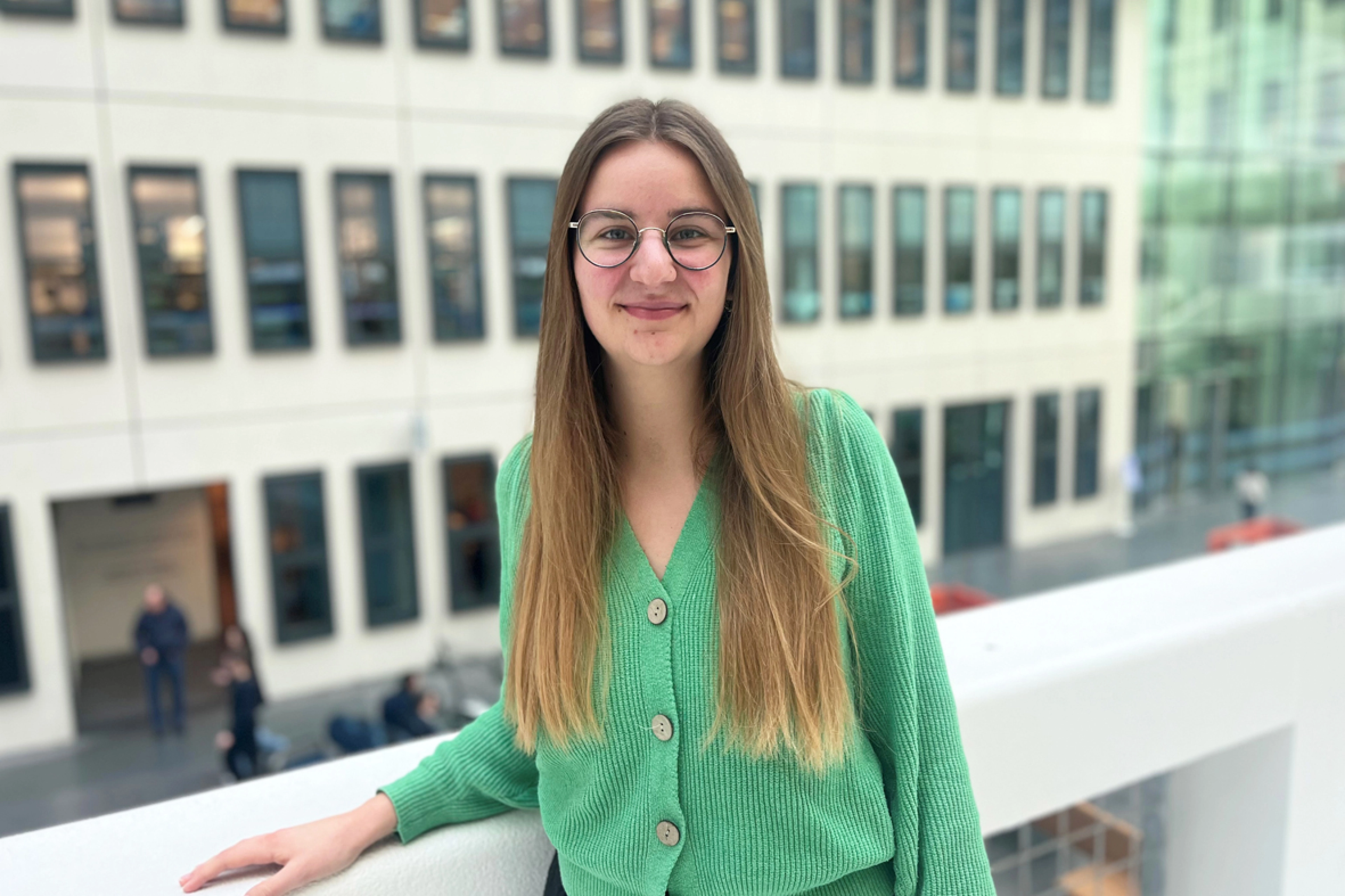
Erasmus MC Genomics Core Facility has welcomed a new bioinformatician: Minouk Noordsij
What Minouk finds most appealing about bioinformatics is working with large-scale datasets. “These datasets are so large that without computational methods, it would be impossible to extract meaningful information. Using bioinformatics techniques, you can identify patterns and insights and the process really feels like solving a puzzle.” The societal relevance of genomics research is an important driver in this work.
A particular area of interest for Minouk is metagenomics. “It studies all micro-organisms within a given environment, which makes it an extremely broad field,” she explains. “It has applications not only in healthcare, such as microbiome research, but also in areas like food production and environmental studies. There is still a lot of development ahead, which makes it especially exciting.”
At the our Genomics Core Facility, Minouk hopes to gain experience with a wide range of data types, techniques and analyses, and values working closely with colleagues from different professional backgrounds. “Collaborating with people from the lab and with researchers is something I really enjoy. You can learn a lot from each other.”
Looking at the growing role of artificial intelligence in bioinformatics, Minouk sees a clear place for human expertise. “A.I. can already do a lot, but it remains crucial that people truly understand what is happening in the analyses. We need to be able to make informed choices and explain them. Human insight is something A.I. cannot replace.”
Related pages
Get in touch
For general inquiries or more information about our services, please contact us.